
I am currently updating some older articles on my blog. While going through posts from 2013, I came across an article I published when I was doing an internship in Cleveland, Ohio.
At the time, I visited the Cleveland Public Library and looked through German-American newspapers preserved on microfilm. I was interested in how German Americans had followed political developments in Germany and Europe. One of the articles I found was published in the Cleveland Wächter und Anzeiger on September 2, 1939, just one day after Germany invaded Poland. Its title was Die deutsch-amerikanischen Beziehungen im Falle eines Krieges (German-American Relations in the Event of War).
When I originally posted the newspaper clipping in 2013, I simply reproduced the image with a short comment. Now, with the help of AI, it is much easier to transcribe the old German newspaper text, printed in Fraktur and scanned in low quality, and translate it into English. This makes it possible to read the article again.
But a lot has changed since 2013.
When I grew up in West Germany, German-American friendship and cooperation were something I took for granted. The United States was not just another country. It was Germany’s most important ally, and the US guaranteed freedom and security in Western Europe. The transatlantic relationship was fundamental to my understanding of politics.
My basic assumption was that we shared common values and interests in the so-called West.
I am no longer so sure about that.
Russia’s invasion of Ukraine has demonstrated that peace and security in Europe cannot be taken for granted any longer. Europe is facing a military threat, and the Western alliance should be more important than ever. Yet, at the same time, the United States seems increasingly concerned with pursuing its own interests rather than being part of a value-based alliance.
What I find particularly disturbing is how quickly things that once seemed unthinkable have become part of political discussions.
Take Greenland, for example. Greenland is part of the Kingdom of Denmark, and Denmark is a NATO ally of the United States. The idea that the United States might threaten the territorial integrity of an allied country would have been almost unimaginable only a few years ago. Now we are seriously discussing American threats concerning Greenland. What seemed unthinkable is becoming thinkable.
Something similar is happening in international trade.
For decades, I understood the United States as a champion of free trade, fair competition, and an international order based on rules and treaties. Certainly, American foreign and trade policy was never free of protectionism and imperialism, and the United States has always defended its economic interests. But there was an underlying commitment to international cooperation.
Today, the United States increasingly seems to use tariffs as an instrument of political pressure. Trade partners, including allies, are threatened with higher tariffs, and international agreements appear to matter less than immediate American interests. At times, this looks less like cooperation between partners and more like the behavior of a bully.
This brings me back to the newspaper article from 1939.
Of course, there can be no comparison between Nazi Germany and the United States today. The Nazi dictatorship, its aggressive expansionism, and its crimes against humanity stand in a completely different historical category. I do not want to suggest any equivalence.
Nevertheless, reading the article today is a strange experience.
The author describes the deterioration of German-American relations on the eve of World War II. Diplomatic relations were strained, ambassadors had been recalled, and trade relations were suffering from tariffs and other restrictions. The article even discusses an additional 25 percent tariff imposed by the United States on German goods.
In 2013, I read this primarily as a historical document from a very different time. The tensions between Germany and the United States seemed to belong to a distant past. After World War II, the US and Western Europe were allies.
Today, some of the issues discussed in the article sound surprisingly familiar. Once again, tariffs, trade restrictions, and political disagreements are putting pressure on relations between Germany, Europe, and the United States. A trade war between Europe and America is no longer an unthinkable scenario.
The historical circumstances are entirely different, but the article raises questions that have become relevant again.
Perhaps what has changed most is my own understanding of the transatlantic relationship. Growing up in West Germany, I assumed that German-American friendship was something stable and lasting. The US is no longer a trustworthy partner. Depending on the US has become a liability.
Reading it again, more than eighty years after its publication, I am struck by how quickly international relationships can change—and how easily things we take for granted can become uncertain.
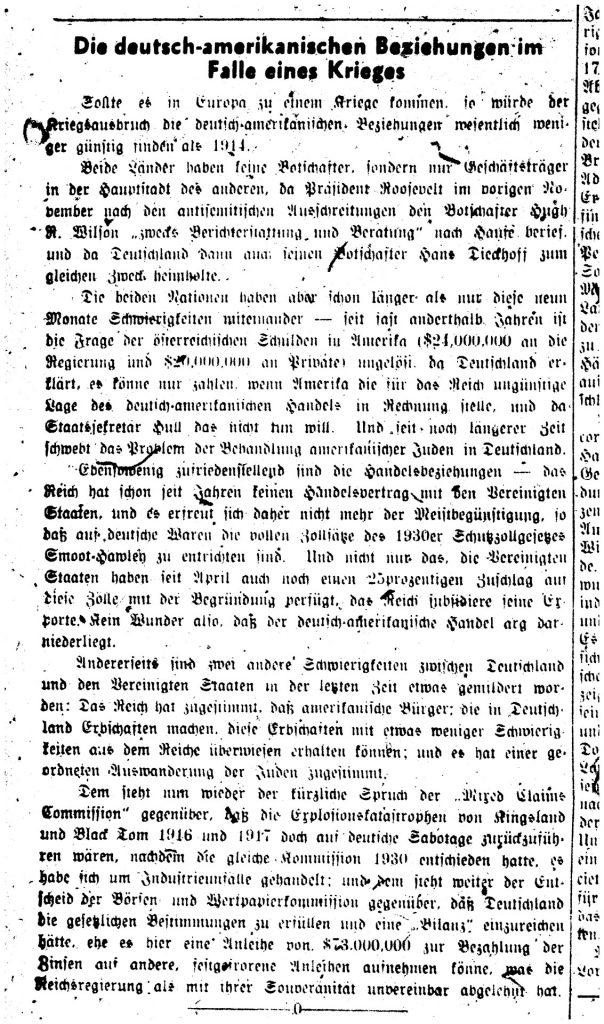
German Original and English Translation
The following is a transcription of the article published in the Cleveland Wächter und Anzeiger on September 2, 1939, accompanied by an English translation. The German transcription preserves the historical spelling and wording of the original newspaper.
Die deutsch-amerikanischen Beziehungen im Falle eines Krieges
German-American Relations in the Event of War
Sollte es in Europa zu einem Kriege kommen, so würde der Kriegsausbruch die deutsch-amerikanischen Beziehungen wesentlich weniger günstig finden als 1914.
Should war break out in Europe, German-American relations would be in a considerably less favorable position at the outbreak of hostilities than they were in 1914.
Beide Länder haben keine Botschafter, sondern nur Geschäftsträger in der Hauptstadt des anderen, da Präsident Roosevelt im vorigen November nach den antisemitischen Ausschreitungen den Botschafter Hugh R. Wilson „zwecks Berichterstattung und Beratung“ nach Hause berief, und da Deutschland dann auch seinen Botschafter Hans Dieckhoff zum gleichen Zweck heimholte.
Neither country has an ambassador in the other’s capital, only a chargé d’affaires. Last November, following the antisemitic attacks, President Roosevelt recalled Ambassador Hugh R. Wilson for “reporting and consultation,” and Germany then recalled its ambassador, Hans Dieckhoff, for the same purpose.
Die beiden Nationen haben aber schon länger als nur diese neun Monate Schwierigkeiten miteinander — seit fast anderthalb Jahren ist die Frage der österreichischen Schulden in Amerika ($24,000,000 an die Regierung und $20,000,000 an Private) ungelöst, da Deutschland erklärt, es könne nur zahlen, wenn Amerika die für das Reich ungünstige Lage des deutsch-amerikanischen Handels in Rechnung stelle, und da Staatssekretär Hull das nicht tun will. Und seit noch längerer Zeit schwebt das Problem der Behandlung amerikanischer Juden in Deutschland.
But the two nations have had difficulties with each other for longer than these nine months. For almost a year and a half, the question of Austrian debts in America ($24,000,000 owed to the government and $20,000,000 to private creditors) has remained unresolved. Germany declares that it can pay only if America takes account of the unfavorable state of German-American trade, which Secretary of State Hull is unwilling to do. And for even longer, the issue of the treatment of American Jews in Germany has remained unsettled.
Ebensowenig zufriedenstellend sind die Handelsbeziehungen — das Reich hat schon seit Jahren keinen Handelsvertrag mit den Vereinigten Staaten, und es erfreut sich daher nicht mehr der Meistbegünstigung, so daß auf deutsche Waren die vollen Zollsätze des 1930er Schutzzollgesetzes Smoot-Hawley zu entrichten sind. Und nicht nur das, die Vereinigten Staaten haben seit April auch noch einen 25prozentigen Zuschlag auf diese Zölle mit der Begründung verfügt, das Reich subsidiere seine Exporte. Kein Wunder also, daß der deutsch-amerikanische Handel arg darniederliegt.
Trade relations are equally unsatisfactory. For years the Reich has had no trade agreement with the United States and therefore no longer enjoys most-favored-nation treatment, so German goods are subject to the full tariff rates of the Smoot-Hawley Tariff Act of 1930. Moreover, since April the United States has imposed an additional 25 percent surcharge on these duties, on the grounds that the Reich subsidizes its exports. It is hardly surprising, then, that German-American trade is in a very poor state.
Andererseits sind zwei andere Schwierigkeiten zwischen Deutschland und den Vereinigten Staaten in der letzten Zeit etwas gemildert worden: Das Reich hat zugestimmt, daß amerikanische Bürger, die in Deutschland Erbschaften machen, diese Erbschaften mit etwas weniger Schwierigkeiten aus dem Reiche überwiesen erhalten können; und es hat einer geordneten Auswanderung der Juden zugestimmt.
On the other hand, two other difficulties between Germany and the United States have eased somewhat recently. The Reich has agreed that American citizens who inherit property in Germany may transfer their inheritances out of the Reich with somewhat fewer difficulties; and it has agreed to an orderly emigration of Jews.
Dem steht nun wieder der kürzliche Spruch der „Mixed Claims Commission“ gegenüber, daß die Explosionskatastrophen von Kingsland und Black Tom 1916 und 1917 doch auf deutsche Sabotage zurückzuführen wären, nachdem die gleiche Kommission 1930 entschieden hatte, es habe sich um Industrieunfälle gehandelt; und dem steht weiter der Entscheid der Börsen- und Wertpapierkommission gegenüber, daß Deutschland die gesetzlichen Bestimmungen zu erfüllen und eine „Bilanz“ einzureichen hätte, ehe es hier eine Anleihe von $73,000,000 zur Bezahlung der Zinsen auf andere, festgefrorene Anleihen aufnehmen könne, was die Reichsregierung als mit ihrer Souveränität unvereinbar abgelehnt hat.
Against this must now be set the recent ruling of the “Mixed Claims Commission” that the explosions at Kingsland and Black Tom in 1916 and 1917 were indeed attributable to German sabotage, after the same commission had ruled in 1930 that they were industrial accidents. There is also the decision of the Securities and Exchange Commission that Germany would have to comply with the legal requirements and submit a “balance sheet” before it could raise a $73,000,000 loan here to pay interest on other, frozen loans—a requirement the Reich government rejected as incompatible with its sovereignty.
Commentary in the Cleveland Wächter und Anzeiger on Sep 2, 1939.